Call centres are under constant pressure to deliver faster, friendlier, and more personalized customer experiences, often with limited budgets and rising contact volumes. Call centre AI solutions are changing that equation by automating routine work, guiding agents in real time, and turning every interaction into valuable insight. By leveraging Contact center AI: boosting omnichannel service, businesses can unify support channels seamlessly, ensuring customers receive consistent experiences across voice, chat, email, and social platforms. Additionally, the benefits of using AI virtual agents for support enable organizations to provide smarter, faster assistance, freeing human agents to focus on complex and sensitive interactions.
Used well, AI does not replace the human touch. Instead, it frees people to focus on complex, sensitive, and relationship‑building conversations, while software handles repetitive tasks with speed and consistency. Many call centres now depend on cutting edge technology to process data efficiently, improve response times, and gain actionable insights. Meanwhile, large scale computing supports real-time analysis, helping agents anticipate customer needs and deliver accurate, personalized support.
In marketing, leveraging AI with smart marketing strategies ensures campaigns reach the right audiences while optimizing engagement and retention. Similarly, effective digital campaigns use insights from customer interactions to refine messaging, boost satisfaction, and support long-term growth.
Financial operations are also enhanced when organizations adopt business finance planning alongside AI-enabled call centre tools. This combination allows companies to forecast staffing requirements, allocate budgets efficiently, and reduce operational bottlenecks, ultimately improving both agent productivity and customer experience.
By integrating technology, marketing, and finance with call centre AI solutions, organizations can build a smarter, more responsive support system that balances automation with the human touch, ensuring customers receive personalized service while agents focus on high-value interactions.
Top 10 Call Centre AI Solutions Providers
Choosing the right call centre AI solutions can significantly improve customer satisfaction, agent efficiency, and overall business operations. Here’s a list of the top providers that are shaping the future of AI-driven contact center services.
1. Bright Pattern – Intelligent AI Contact Center Solutions
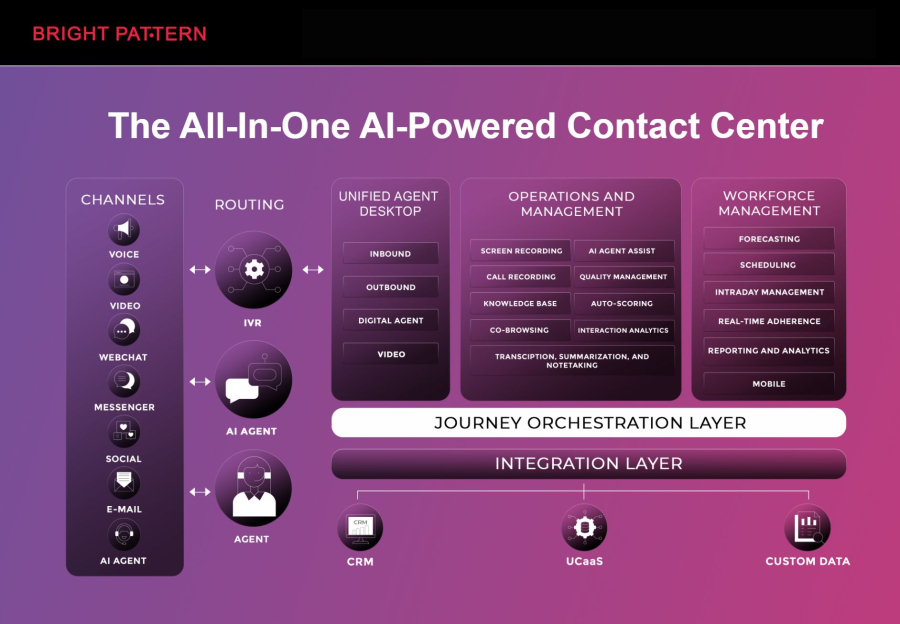
Bright Pattern is recognized as a leading provider of call centre AI solutions, helping businesses automate customer interactions, provide real-time agent guidance, and optimize omnichannel support. Their platform focuses on delivering seamless experiences across voice, chat, email, and messaging channels.
Key features include:
- AI-powered virtual agents for handling routine inquiries
- Real-time guidance and recommendations for live agents
- Omnichannel communication with a unified interface
- Analytics and reporting to optimize agent performance
- Easy integration with CRM and business applications
Bright Pattern’s solutions are designed to improve operational efficiency while maintaining the human touch, enabling businesses to scale support without compromising service quality.
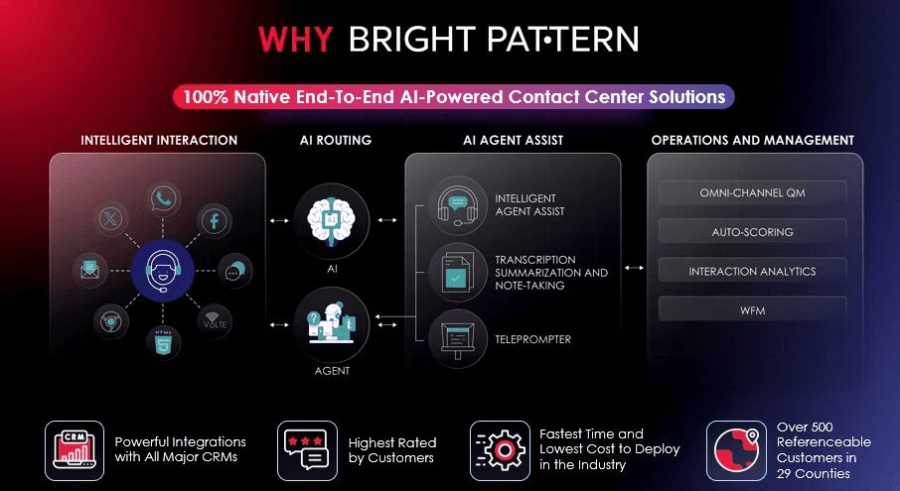
2. Genesys – AI-Driven Customer Experience Platform
Genesys offers advanced AI capabilities for contact centers, including predictive routing, chatbots, and analytics. Their platform supports seamless integration with multiple communication channels, helping organizations provide faster and personalized responses.
3. Five9 – Cloud Contact Center Software
Five9 leverages AI to enhance agent productivity and automate customer interactions. It includes intelligent routing, virtual assistants, and real-time analytics to ensure consistent and efficient customer service.
4. NICE inContact – CX Cloud Platform
NICE inContact provides a cloud-based contact center solution with AI-powered tools for customer engagement. Features include automated interactions, speech analytics, and workforce optimization to boost efficiency and satisfaction.
5. Talkdesk – AI Customer Service Solutions
Talkdesk offers a cloud-based AI contact center platform with virtual agents, predictive analytics, and omnichannel support. The system helps organizations resolve inquiries faster and improve agent productivity.
6. Cisco Contact Center – Intelligent Communication Solutions
Cisco provides AI-powered tools for contact centers, including automated assistants, data-driven insights, and workflow automation. Their platform enables businesses to enhance customer engagement while streamlining operations.
7. Avaya OneCloud – AI-Powered Contact Center
Avaya’s AI-driven contact center solution offers conversational AI, analytics, and omnichannel support. It focuses on improving agent performance and delivering a seamless customer experience across channels.
8. 8x8 Contact Center – Cloud AI Solutions
8x8 provides an AI-enabled cloud contact center platform with features like virtual agents, real-time monitoring, and data analytics to improve customer satisfaction and operational efficiency.
9. RingCentral Contact Center – Smart Customer Engagement
RingCentral offers AI capabilities for intelligent routing, chatbots, and workforce analytics. Their platform helps contact centers deliver personalized customer service while optimizing agent performance.
10. Zendesk – AI and Automation for Customer Support
Zendesk combines AI with workflow automation to streamline customer interactions. Their tools help agents respond faster, provide insights, and manage multiple communication channels effectively.
What Are Call Centre AI Solutions?
Call centre AI solutionsare software tools that use artificial intelligence and machine learning to understand customer requests, automate workflows, and assist human agents across voice and digital channels.
They typically plug into your existing contact centre systems, such as your phone platform, CRM, ticketing tools, and knowledge base, to make them work smarter together.
Key components of call centre AI
- Conversational AI and virtual agentsthat can understand natural language and handle common queries through voice or chat.
- Agent assistthat listens to or reads live interactions and suggests next best actions, responses, or knowledge articles.
- AI routing and prioritizationthat matches customers to the best available resource based on intent, value, and context.
- Quality monitoring and analyticsthat automatically review interactions for quality, compliance, and sentiment.
- Workforce optimizationthat forecasts demand and helps schedule the right number of agents at the right time.
Core Capabilities of Modern Call Centre AI
Modern AI solutions cover every part of the contact centre, from how customers first reach you to how you learn from every conversation.
1. Virtual agents and AI‑powered IVR
AI‑driven virtual agents can answer questions, authenticate customers, update records, and complete transactions without a human agent. Unlike traditional touchtone IVR, conversational AI can understand phrases like “I want to change my delivery address” instead of forcing callers through rigid menu trees.
- Available 24/7 across phone, web chat, messaging apps, and more.
- Handles high‑volume, repetitive tasks consistently.
- Transfers to human agents with full context when needed.
2. Agent assist and real‑time guidance
Agent assisttools support human agents during live conversations by:
- Surfacing relevant knowledge articles or FAQs based on what the customer says or types.
- Suggesting responses, compliance statements, or next best actions.
- Highlighting potential upsell or cross‑sell opportunities.
- Flagging risk signals, such as frustration or cancellation intent, in real time.
This not only boosts speed and accuracy but also shortens the time it takes to bring new agents up to full productivity.
3. Intelligent routing and personalization
AI can analyze customer intent, previous interactions, and profile data to decide where a contact should go. Instead of routing based solely on dialed number or language, AI can:
- Send high‑value customers to specialized teams.
- Route technical issues directly to advanced support.
- Prioritize urgent cases, such as outages or payment problems.
- Match customers with agents who have the right skills or history with that account.
4. Automated quality management and compliance
Traditional quality assurance relies on manually listening to a small sample of calls. AI can revieweveryinteraction, across voice and digital channels, to:
- Check whether mandatory disclosures and scripts are used.
- Identify compliance risks or sensitive language.
- Measure sentiment and effort levels over time.
- Spot coaching opportunities for individual agents or teams.
5. Analytics and insight generation
Call centre AI turns raw interaction data into clear, actionable insights. It can summarize calls, categorize reasons for contact, and highlight emerging issues so you can fix root causes, not just handle symptoms.
Business Benefits of Call Centre AI Solutions
When implemented thoughtfully, call centre AI solutions deliver measurable value across customer experience, operational efficiency, and employee satisfaction.
1. Faster responses and reduced wait times
- Virtual agents handle routine questions instantly, cutting queue lengths for more complex issues.
- Agent assist reduces time spent searching for answers, shrinking average handle time.
- Smart routing gets customers to the right place on the first try.
2. 24/7 availability without 24/7 staffing
AI never sleeps. Virtual agents can support customers outside normal working hours, on weekends, and across time zones. This always‑on capability is particularly valuable for global businesses and digital‑first brands.
3. Lower operational costs with higher quality
- Automation offloads repetitive, low‑value interactions from human agents.
- Better forecasting and scheduling reduce overstaffing and understaffing.
- Continuous quality monitoring helps maintain high standards without expanding QA headcount.
4. Improved customer satisfaction and loyalty
Customers feel the difference when service is fast, accurate, and personalized. Call centre AI contributes to higher satisfaction by:
- Reducing transfers and repeat contacts.
- Ensuring consistent, up‑to‑date information across channels.
- Adapting to customer preferences and history.
- Detecting and de‑escalating frustration early in the interaction.
5. Happier, more effective agents
AI takes over routine tasks and provides real‑time support so agents can focus on the conversations where they add the most value. This leads to:
- Less repetitive work and burnout.
- Shorter onboarding times for new hires.
- More time for problem solving and relationship building.
- Clearer feedback from AI‑powered coaching insights.
Practical Use Cases for Call Centre AI
Call centre AI solutions are flexible and can be tailored to different industries, channels, and business goals. Here are some of the most impactful use cases.
Customer service and technical support
- Answering common questions about orders, accounts, billing, or status updates.
- Guiding customers through password resets or basic troubleshooting.
- Identifying when an issue is complex and routing to a specialist with full context.
Sales and revenue generation
- Qualifying leads via virtual agents before passing them to sales teams.
- Recommending relevant products or plans based on customer needs and history.
- Alerting agents to upsell opportunities during live conversations.
Collections and billing support
- Sending proactive reminders about upcoming or overdue payments.
- Allowing customers to set up payment plans through self‑service.
- Flagging high‑risk accounts for human follow up.
Industry‑specific examples
- Telecommunications: Plan changes, usage queries, outage notifications, device troubleshooting.
- Banking and financial services: Card activation, balance inquiries, card locking, basic dispute initiation.
- Retail and e‑commerce: Order tracking, returns and exchanges, product availability, loyalty points.
- Utilities: Meter readings, moving house notifications, payment arrangements, outage updates.
- Healthcare: Appointment scheduling, pre‑visit instructions, basic benefits questions, non‑clinical FAQs.
How Call Centre AI Works (Without the Jargon)
While the underlying technology can be complex, the basic flow of a call centre AI interaction is straightforward.
1. Understanding customer intent
The AI usesnatural language processingto interpret what the customer says or types. It identifies the intent, such as “reset password” or “update address”, and extracts key details like account numbers or dates.
2. Accessing data and business rules
The system connects to your CRM, billing, order management, and other platforms to retrieve the information it needs. It follows your business rules to decide what it can do automatically and when it must transfer to a human.
3. Responding and completing actions
Depending on the scenario, the AI may:
- Provide an answer using your knowledge base.
- Execute a transaction, such as updating contact details.
- Collect additional information needed to progress the case.
- Hand off to an agent and pass through the full interaction history.
4. Learning and improving over time
Modern call centre AI solutions learn from new data. As more interactions are handled, they can be tuned to better understand your customers, reduce errors, and expand the range of tasks handled automatically.
Building a High‑Impact Call Centre AI Strategy
A successful AI program starts with clear goals and a phased approach. Rushing into complex automation without a strategy can limit results and adoption.
Step 1: Define your objectives
Common objectives include:
- Reducing average handle time or queue times.
- Improving customer satisfaction or first contact resolution.
- Expanding self‑service options.
- Supporting growth without proportional headcount increases.
Step 2: Map customer journeys and pain points
Identify where customers struggle today. Look for:
- High‑volume, repeatable contacts that are ideal for automation.
- Complex or high‑value interactions where agent assist would add value.
- Breakpoints where customers are transferred, put on hold, or need to call back.
Step 3: Assess your data and systems
AI is only as powerful as the data and systems it connects to. Confirm that:
- Your customer and interaction data is reasonably accurate and accessible.
- You have or can create a structured knowledge base.
- Your telephony, CRM, and ticketing systems can integrate with AI tools.
Step 4: Prioritize use cases
Start with a small number of high‑impact, low‑risk use cases, such as order tracking, simple account queries, or password resets. These deliver quick wins and build confidence before expanding to more complex processes.
Step 5: Pilot, measure, and scale
Run controlled pilots, measure outcomes, and refine your AI models and workflows. Once you have proven value, expand to additional channels, regions, or lines of business.
Features to Look For in Call Centre AI Solutions
Choosing the right solution means looking beyond buzzwords and focusing on capabilities that directly support your goals.
| Feature | Why it matters |
| Omni‑channel support | Delivers a consistent experience across voice, chat, email, and messaging with shared context. |
| Natural language understanding | Allows customers to speak or type naturally instead of using rigid menus or keywords. |
| Low‑code or no‑code design tools | Enables contact centre and operations teams to update flows without heavy developer support. |
| Deep integrations | Connects smoothly with your telephony, CRM, ticketing, and back‑office systems. |
| Real‑time analytics | Provides live dashboards, alerts, and insights to optimize performance quickly. |
| Security and compliance controls | Supports encryption, data masking, and audit trails to protect customer information. |
| Scalability and reliability | Handles peak volumes without performance degradation, ensuring stable operations. |
| Continuous learning and optimization | Improves intent recognition and outcomes over time with built‑in machine learning. |
Implementation Best Practices for Call Centre AI
The way you roll out call centre AI is just as important as the technology you choose. These best practices help maximize adoption and returns.
Bring agents into the process early
- Involve frontline teams in designing AI flows and identifying use cases.
- Position AI as a co‑pilot that removes drudgery, not as a replacement.
- Gather feedback from agents during pilots and incorporate it into refinements.
Start simple, then expand capabilities
- Begin with well‑defined, low‑complexity interactions to prove value quickly.
- Avoid trying to automate every process at once.
- Use early results to secure buy‑in for broader initiatives.
Invest in knowledge and content
AI performs best when it has clear, accurate information to draw from. Regularly update your knowledge base, scripts, and process documentation so both virtual agents and human agents can give consistent answers.
Design safe and smooth handoffs
- Make it easy for customers to reach a human agent when needed.
- Pass full interaction transcripts and data to avoid forcing customers to repeat themselves.
- Set clear rules for when to transfer from AI to human support.
Ensure privacy, security, and compliance
- Clarify how customer data is used, stored, and retained.
- Use appropriate safeguards for sensitive information and authentication steps.
- Align AI implementations with relevant regulations in your markets.
Measuring the Success of Call Centre AI
To demonstrate value and guide ongoing optimization, define measurable targets before you deploy. Useful metrics include:
- Containment ratefor virtual agents: the percentage of interactions fully resolved by AI without human help.
- Average handle time: changes in call or chat durations when AI is assisting.
- First contact resolution: whether issues are solved in a single interaction.
- Queue times and abandonment: reductions due to AI absorbing volume.
- Customer satisfaction scoresand feedback on both AI and human interactions.
- Agent satisfaction and turnover: the impact of AI on workload and engagement.
Common Myths About Call Centre AI
Despite growing adoption, several misconceptions still hold some organizations back. Addressing them helps build a realistic and positive vision of what is possible.
Myth 1: AI will replace human agents
In practice, AI is most effective as a partner to human agents, not a replacement. It handles repetitive, structured tasks while people focus on empathy, judgment, and complex problem solving. The result is usually abetterexperience for both customers and employees.
Myth 2: Only large enterprises can benefit
Cloud‑based call centre AI solutions make advanced capabilities accessible to organizations of many sizes. Smaller teams can start with targeted automations and scale as their needs grow.
Myth 3: Implementing AI requires a complete technology overhaul
Most modern solutions are designed to integrate with existing phone systems, CRMs, and help desk tools. You can introduce AI gradually, without disrupting your core operations or replacing major platforms immediately.
Myth 4: Customers dislike talking to AI
Customers typically dislikebadautomation — rigid menus, dead ends, and confusing bots. Well‑designed AI that is transparent, fast, and helpful is often preferred for simple tasks, especially when customers know they can reach a person easily if needed.
The Future of Call Centre AI
Call centre AI is evolving quickly, opening up new opportunities to differentiate your customer experience. Emerging trends include:
- More natural conversations: Ongoing advances in language models are making AI interactions smoother and more human‑like.
- Hyper‑personalization: Deeper integration with customer data enables tailored offers, messages, and solutions in real time.
- Proactive support: AI can predict issues, detect patterns, and reach out with solutions before customers even contact you.
- Unified insights across channels: Voice, chat, email, and messaging analytics will merge into a single, holistic view of the customer journey.
Conclusion: Turning Your Call Centre into a Strategic Advantage
Call centre AI solutions are no longer experimental tools. They are practical, proven enablers of faster service, lower costs, and more satisfying customer and employee experiences. When you combine the strengths of intelligent automation with your team’s expertise and empathy, your call centre shifts from a cost centre to a powerful driver of loyalty and growth.
By starting with clear objectives, choosing the right capabilities, and rolling out AI in a thoughtful, human‑centric way, you can build a modern contact centre that is more resilient, more efficient, and far more rewarding to use and to work in.
